

- University
- Academic
- Schools/Vocational Schools
- Vocational School of Justice
- Vocational School
- Vocational School
- Department of Banking and Insurance (Turkish)
- Department of Computer Programming (Turkish)
- Department of Foreign Trade (Turkish)
- Department of Graphic Design (Turkish)
- Department of Interior Design (Turkish)
- Department of Construction Technology (Turkish)
- Department of Occupational Health and Safety (Turkish)
- Department of Media and Communication (Turkish)
- Department of Architectural Restoration (Turkish)
- Department of Radio and Tv Programming (Turkish)
- Department of Civil Aviation Cabin Services (Turkish)
- Department of Civil Aviation Transportation Management (Turkish)
- Department of Tourism and Hotel Management (Turkish)
- Department of Applied English Translation
- Vocational School Of Health Services
- Vocational School Of Health Services
- Department of Child Development (Turkish)
- Department of Physiotherapy (Turkish)
- Department of Paramedic (Turkish)
- Department of Opticianry (Turkish)
- Department of Medical Documentation and Secreteriat (Turkish)
- Department of Medical Imaging Techniques (Turkish)
- Department of Medical Laboratory Techniques (Turkish)
- Department of Elderly Care (Turkish)
- School of Applied Management Sciences
- School of Foreign Languages
- Faculties
- Faculty of Arts and Sciences
- Faculty of Fine Arts and Design
- Faculty of Law
- Faculty of Communication
- Faculty of Business
- Faculty of Engineering
- Faculty of Engineering
- Department of Computer Engineering
- Department of Biomedical Engineering
- Department of Electrical and Electronics Engineering
- Department of Industrial Engineering
- Department of Food Engineering
- Department of Genetics and Bioengineering
- Department of Aerospace Engineering
- Department of Civil Engineering
- Department of Mechanical Engineering
- Department of Mechatronics Engineering
- Department of Software Engineering
- Faculty of Health Sciences
- Medicine
- Graduate School
- Common Courses
- Schools/Vocational Schools
- Research
- Research Centers
- Library
- Smart Campus
- Technology Transfer Office
- İzmir Sciencepark
- Continuous Education Center (EKOSEM)
- Children's University
- Ethics Committee
- Teaching and Learning Center (EKOEĞİTİM)
- Psychology Application and Research Center
- Researcher Training Coordinatorship
- Research Collaborations And Innovation Coordinatorship
- Campus
- INTERNATIONAL
- Contact
- 25TH YEAR
VOCATIONAL SCHOOL OF HEALTH SERVICES
Department of Child DevelopmentKey Performance Indicators
Aim 1. Educating Qualified and Competent Child Development Professionals
Objective 1.1. To enable students to correctly apply fundamental theories and principles of child development (physical, cognitive, language, and social-emotional) in their professional practice.
KPI 1.1.1. Graduate employment rate (%)
KPI 1.1.2. Employer satisfaction surveys (% satisfaction)
KPI 1.1.3. Student and graduate satisfaction surveys (% satisfaction)
Objective 1.2. To educate competent individuals who can conduct practice processes within the framework of children’s rights and professional ethical principles, and who are capable of applying current legal regulations in their field.
KPI 1.2.1. Course success average (%) in courses including topics on children’s rights and professional ethics (CG 212, CG 106, CG 201, CG 202, CG 222, CG 204)
KPI 1.2.2. Number of activities conducted by students with children related to children’s rights
Objective 1.3. To enable students to conduct teamwork by establishing professional and effective communication with families, teachers, and relevant disciplines (psychologists, social workers, etc.).
KPI 1.3.1. Number of role-play activities based on scenarios within the “Child and Communication” course (count)
Aim 2. Providing Applied Education Opportunities
Objective 2.1. To equip students with the ability to plan, implement, and evaluate science-based activities addressing all developmental domains of preschool children.
KPI 2.1.1. Success rate (%) in examinations of professional practice courses
Objective 2.2. To train students to design safe, cost-effective, and creative educational tools/materials and toys based on children’s developmental characteristics and the needs of disadvantaged groups.
KPI 2.2.1. Success rate (%) in the Instructional Technologies and Material Design course
Objective 2.3. To ensure effective use of current digital tools and technologies in educational processes and material design.
KPI 2.3.1. Average success rate (%) in courses involving digital material design (animation, interactive stories, etc.), such as Child and Music and Child, Science and Technology courses
KPI 2.3.2. Percentage of students using digital portfolios in educational processes (%)
Aim 3. Developing Analytical, Creative Thinking and Problem-Solving Skills
Objective 3.1. To enable students to analyze behavioral or developmental problems encountered in educational settings and develop science-based solutions.
KPI 3.1.1. Success rate (%) in case analysis quizzes in Special Education II and Child Mental Health courses
Objective 3.2. To enable students to evaluate existing educational approaches and practices from the perspective of child welfare.
KPI 3.2.1. Average academic grade (%) of assignments in the “Teaching Methods and Techniques” course involving critical analysis of current education systems
Objective 3.3. To design original learning environments that are learner-centered, curiosity-driven, and supportive of exploration.
KPI 3.3.1. Average success rate (%) in courses such as Vocational Education Practice III, Instructional Technologies and Material Design, Child Art and Creativity, and Child, Science and Technology
Aim 4. Supporting Professional and Personal Development
Objective 4.1. To develop the habit of following national and international developments, scientific publications, and new educational models in the field.
KPI 4.1.1. Number of seminars/webinars organized within the program (count)
KPI 4.1.2. Student participation in academic activities (e.g., DGS, double major programs, Erasmus+ activities, student research projects, project courses, seminars, congresses, conferences, workshops, etc.) (number/year)
Objective 4.2. To guide students toward social responsibility projects aimed at raising awareness on topics such as society, child development, and the prevention of child neglect and abuse.
KPI 4.2.1. Number of social responsibility projects conducted in collaboration with local authorities or NGOs (e.g., EÇEV, LÖSEV, etc.)
KPI 4.2.2. Number of target group members (parents/children) reached through projects and feedback survey results
Objective 4.3. To develop flexible professional skills that enable students to adapt to the changing labor market and diverse service areas (play groups, NGOs, children’s homes, special education centers, etc.).
KPI 4.3.1. Number of projects conducted with NGOs and children with special needs within the Vocational Education and Practice III course (count)
NEWSALL NEWS


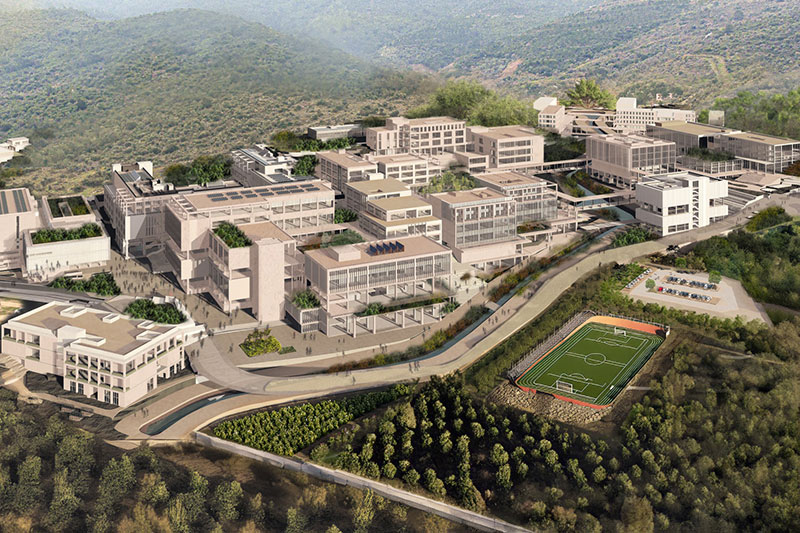
IZMIR UNIVERSITY OF ECONOMICS GÜZELBAHÇE CAMPUS
DetailsGLOBAL CAREER
As Izmir University of Economics transforms into a world-class university, it also raises successful young people with global competence.
More..CONTRIBUTION TO SCIENCE
Izmir University of Economics produces qualified knowledge and competent technologies.
More..VALUING PEOPLE
Izmir University of Economics sees producing social benefit as its reason for existence.
More..
You are one step ahead with your graduate education at Izmir University of Economics.